A Dickensian hot mess
Why marketing’s first job is to represent your customers
I trust this email finds you bright eyed and bushy tailed this Sunday morning. Unless of course you implicitly attended a work event last night? If so, hopefully IMTW will perk you up.
👉🏻 Read on to learn why:
① Empathy is the litmus test for effective communications.
② Marketing should be as close as possible to your customers.
③ Fintech has Wall Street stalwarts spooked.
④ Your marketing channels must be optimised for mobile.
⑤ Earning your audience’s attention will be harder than ever.
⑥ Financial B2B social media can be witty, fun and…daring.
⑦ Fostering your people will take you from good to great.
What's new?
This week, an energy supplier advised its customers, without even a hint of irony, to cuddle their pets to stay warm. If I hadn’t first seen it on Twitter, then the following morning been woken by it featuring on Radio 4’s Today before reading the details in the FT, I might not have believed it…

In short:
“Britain’s third-biggest energy supplier has sparked anger after it emailed its customers ‘10 simple and cost effective ways to keep warm this winter’, such as having ‘a cuddle’, eating ‘hearty bowls of porridge’ and sticking to ‘non-alcoholic drinks’. Also included is a recommendation to ‘get moving’ by ‘challenging the kids to a hula-hoop contest’, cleaning the house or ‘doing a few star jumps’.”
“MPs called the advice issued by a division of Ovo Energy ‘insulting’ and ‘offensive’.” [And they should know.]
“Britons are facing the biggest squeeze on their incomes since the financial crisis of 2008-09. Energy bills for millions of households are in April expected to rise by more than 50 per cent, or £700, to £2,000 a year per household, when Britain’s energy price cap is adjusted.”
Why does it matter?
Where to start with this Dickensian hot mess? Well, let’s look for the positive, shall we? In theory at least, the email gets some things right by following advice you’ve heard me offer here before:
Identify issues that matter to your customers
Create and share content that adds value
Don’t talk about your product but instead on ways to solve your customers’ problems
Practical tips, offered in numbered list form, are consistently well read
① So how did what started as an innocuous - and seemingly helpful - customer communication end in universal condemnation from British politicians, a shaming in the headlines of the BBC’s flagship current affairs programme, and a scathing piece of coverage on the front page of the world’s most respected business newspaper? Simple: it lacked even a modicum of empathy.
As I concluded when we discussed Revolut’s disastrous menstruation campaign a couple of months ago, the most important check before a communication goes out the door is ‘how will the recipient feel when reading this?’ No one who actually was concerned about rising energy costs would find the contents of this email anything other than condescending and disrespectful.
What's next?
Take action
② I would argue that your marketing team’s most important role is to be the voice of your customer across your organisation - in all discussions about any interaction a customer might have with your brand.
That means they should be completely in touch with your customers’ passions, problems and preoccupations. And, if you have even an inkling that they may not be, it’s time to:
Invest some time in market research, preferably with in person workshops rather than desk bound.
Get your marketing and sales/business development people working hand in glove.
Ensure your marketing people are regularly taking part in customer meetings - even if only as observers.
Get help
Visit InMarketing, my resource library for leaders in finance or technology who want to innovate, interact and influence.
If you have a question, just hit ‘reply’ or send me a tweet.
Share
Can I ask you a favour? If you found this useful or know someone who would, please share it. It really helps me to grow the community of regular IMTW readers.
What else?
Three other articles that are worthy of your time.
FINANCE
JPMorgan plots ‘astonishing’ $12bn tech spend to beat fintechs
③ Fintech has Wall Street stalwarts spooked.

“JPMorgan stunned analysts with a forecast that expenses would increase by 8 per cent this year to around $77bn, meaning it would probably miss a key profitability target in 2022, and possibly in 2023.”
“'The global technology spend at around $12bn, that’s an astonishing number,‘ said James Shanahan, an analyst with Edward Jones. 'That probably blows away the cumulative dollar value of investment of all the fintechs in the world that are trying to disrupt them’.”
“The big spending reflects the pressure on banks to compete with financial technology companies like payments processor Stripe, instalment lender Affirm and challenger bank Chime.”
TECHNOLOGY
People spend a third of their waking day staring at their phones
④ Your digital marketing channels must be optimised for mobile.

“In 2021, people in the world’s top 10 mobile markets for Android spent a solid 4.8 hours browsing apps, according to app analytics company App Annie’s State of Mobile 2022 report. That’s roughly a third of our waking hours.”
“Brazil and Indonesia were the countries with the highest usage (both clocking up a solid 5.4 hours on average), while the U.S. came in 10th with 4.2 hours per day (an hour more than Americans spend watching TV), and the UK came in 12th with four hours per day.”
“Usage has increased 30 percent since 2019.”
MEDIA & MARKETING
Reuters Institute predictions for 2022
⑤ Earning your audience’s attention will be harder than ever this year.

“The Reuters Institute for the Study of Journalism publishes predictions every year based on interviews with news industry leaders to share knowledge about trends publishers need to pay attention to in the year ahead. For its 2022 report, it surveyed 246 news leaders from 52 countries or territories, including 57 editors-in-chief, 53 CEOs or managing editors, and 31 heads of digital or innovation. The nine trends you need to know about are:
Subscriptions and memberships are the number one priority
Mainstream media will poach talent back from platforms
Podcasts, newsletters and digital videos even more important
Hybrid working is here to stay
More solutions, less confrontation
Focus on safety
Reporting climate change
Platforms and regulation
Artificial intelligence and metaverse”
Well said
⑥ Veera Dagbagli, Intern Group Communications & Marketing at Deutsche Börse, when posting a text message from her boss to the company LinkedIn account:
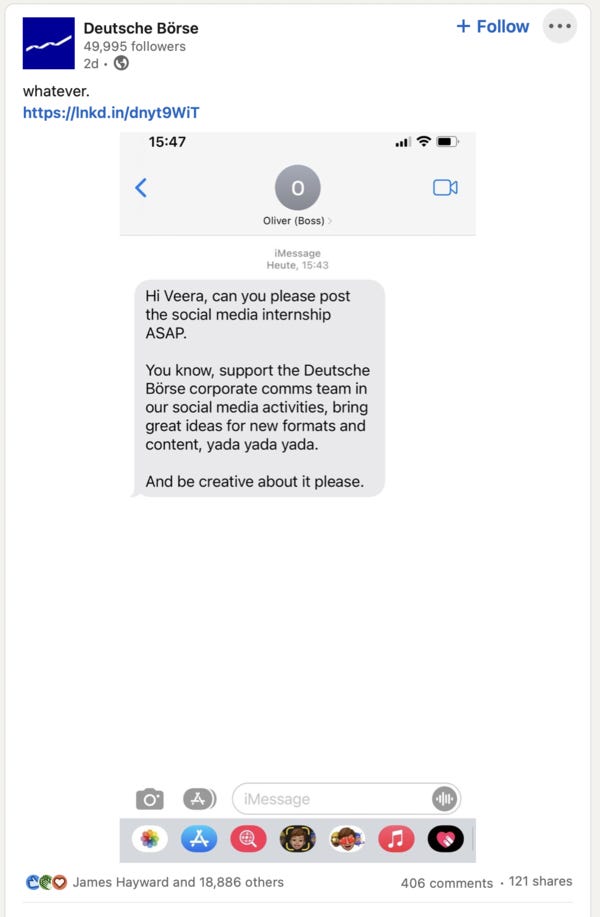
“whatever.”
One more thing...

⑦ Hubert Joly, the former chairman and CEO of Best Buy, and a senior lecturer at Harvard Business School, argues this week that the secret ingredient for thriving companies is what he calls ‘human magic’. You achieve it by creating a workplace with:
Meaning
Authentic human connections
Psychological safety
Autonomy
A learning environment
Growth
Off cuts
The stories that almost made this week’s newsletter.
FINANCE
🦾 UBS digital expert exits for fintech role
🥂 Barclays to merge wealth and private bank arms
🇨🇳 JP Morgan to bolster private banking arm in Asia
🇩🇪 A new president for the Bundesbank
👨🏼🌾 Deutsche Bank UK wealth management CEO to retire
TECHNOLOGY
🇨🇭 While the stuffy Lords Committee pours cold water on UK CBDC, the Swiss quietly complete wholesale CBDC trial
🇪🇺 Revolut launches as a bank in 10 Western European countries
👮🏻♂️ UK regulator to increase oversight on cloud banking giants
📉 Wise shares tank on Citi analyst note
MEDIA & MARKETING
👨🏻🎨 Why UX design is important for B2B companies
🏓 Paddle appoints Andrew Davies as CMO
🐦 Twitter rolling out option to record and replay Spaces to all users
🛒 Who is the new B2B buyer and how do you connect with them?
👩🏻💻 MRM appoints Rebecca Christensen as head of marketing
Don’t settle for marketing.
Aspire to InMarketing: innovate, interact, influence.
Have a productive week.
