Faster horses
Why you’re better off serving a smaller segment than chasing the crowd with everyone else
It’s Sunday morning and here’s your weekly showcase of news likely to impact you, delivered with insight on why it matters and ideas on what to do about it.
👉🏻 Read on to learn why:
① Women are underrepresented and underpaid.
② Not enough marketing helps us really stand out.
③ The fight against climate change will define finance.
④ Fintech has reached UK mass adoption.
⑤ Sometimes less is more.
⑥ Agreeing to disagree is grown-up. And can be profitable.
⑦ Meetings should be run more like juries.
What's new?
Investment Week reported on the fall in the number of female fund managers.

Source: Investment Week, 13 October 2021
① In short:
“The percentage of female UK fund managers has fallen over the past 20 years and sits at just 11.2% (it was 14% at the end of September 2000), with the majority being equity managers and only a small proportion making up the fixed income market.”
“A closer look reveals just 8% of fixed income managers are female, while multi-asset and equity have 10% and 13% female managers respectively.”
“Experts admit the lack of female fund managers is playing a role in the stubborn gender pay gap. Reports from Bloomberg showed asset management firms were failing to close the gap with women being paid about 26% less than their male peers, not much better than the 2017 figure of 29%.”
Why does it matter?
I sent this story to a friend of mine who manages emerging market equity funds for a global asset manager (one with a female CEO, I might add). She replied merely with the head palm emoji. And who can blame her? As Helena Morrissey points out this week, “the latest bonus gaps are as high as 80% (yes, women earning just 20p on average for every £1 in men’s bonuses) and some firms have gone backwards.”
Even if, for reasons I will never understand, you don’t care much about equality, it just makes cold, hard financial sense to hire more female managers. There is overwhelming research to show that they are better at managing risk and connecting with clients. And that diversity of thought leads to better investment decisions.
So why isn’t it happening more? And why don’t clients themselves force a change? After all, 50% of them are women, you would think they would want women managing their money. Perhaps we can find a clue in Merryn Somerset Webb’s FT opinion piece about assessing fund managers. While considering whether all fund managers in the UK should have skin in the game, Webb notes that a study from Morningstar’s Russell Kinnel made it clear that costs are one of the better proven predictors of future fund performance and concludes that fees are what most clients care about. They’re easy to understand and simple to interpret.
② Must we conclude then that more funds are not being run by women because customers simply aren’t asking for it? If so, this illustrates how too often marketing and product development focuses on what research tells us is most important to clients. The problem is that everyone’s reading the same research. As a result, all of our marketing - and our products - end up looking eerily similar. I’m reminded of the quote (dubiously) attributed to Henry Ford: “If I had asked people what they wanted, they would have said faster horses.” We are missing opportunities to really stand out from the crowd because we lack the courage of our convictions.
What's next?
Take action
Ask your head of marketing this week about how your products or services could be better differentiated. Find the niche for whom they are really compelling and go all-in on that.
If you’re an asset manager, of course performance is important, but what’s different about your funds?
If you’re a retail bank, it goes without saying that your accounts should be secure and easy to access, but what makes them better than all the others?
If you’re a securities services provider, mitigating risk and lowering costs is a given, but how is choosing you over your competitor really going to benefit your client?
Better to appeal in a strong, visceral way to a smaller segment than to lump yourself in with everyone else and hope for the best.
Get help
I’m looking for a full-time, in-house role but in the post-Covid age of depleted marketing budgets and remote teams with skills gaps, many organisations need marketing and communications support that’s agile, flexible, and risk free. That’s why I founded WhatsNext Partners.
Whether it be as a permanent member of your team or with on demand support, just hit ‘reply’ to let me know if you need my help.
Share
Can I ask you a favour? If you found this post useful or know someone who would, please like, comment on, or - best of all - share it with your professional network. It really helps me to grow the readership.
What else?
Three other articles that are worthy of your time.
FINANCE
Mark Carney urges collective action on climate change
③ Much more than an investment theme or a management fad, the fight against climate change will be the driving force of change in finance for decades.
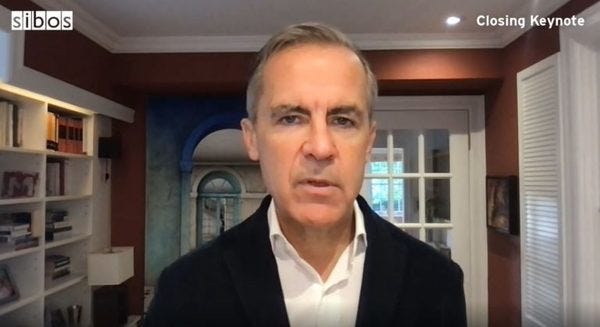
Mark Carney. Source: FintechFutures, 15 October 2021
“Mark Carney, UN special envoy on climate action and finance and former governor of the Bank of England, provided the closing keynote for Sibos 2021, addressing how the collective power of the financial services industry can tackle climate change.”
“Carney says that, with almost $100 trillion worth of assets committed to net-zero, the global financial system is at a tipping point when it comes to climate change, but adds that finance doesn’t operate in isolation, and governments must also pull their weight.”
“He says the world needs $100-150 trillion to move to net-zero, half of which will be spent in Asia over the next three decades. And companies cannot just sit on the sidelines as new reporting metrics are going to affect valuations quite substantially.”
TECHNOLOGY
Most Brits now have 2.8 fintech apps on their smartphones
④ Fintech has reached UK mass adoption, driven by Covid lockdown.

Source: AltFi, 13 October 2021
“The average UK consumer now has 2.8 fintech apps installed and Brits are planning to increase the number of fintechs they have installed to 3.5 apps over the next six months.”
“79 per cent of people say they use fintech apps either for banking or to pay for goods and services.”
“76 per cent) feel confident using open banking to manage their finances. The top perceived benefits from those already using it include time (59 per cent) and money-saving (42 per cent), as well as greater stress reduction (36 per cent).”
MEDIA & MARKETING
Jony Ive’s LoveFrom unveils official website
⑤ Sometimes less is more.

Lovefrom.com. Source: Wallpaper, 11 October 2021
“LoveFrom, the creative collective founded by Jony Ive which includes his long-time collaborator Marc Newson, has unveiled its website. The launch marks the most public move to date by the collective, which has worked quietly since its founding in 2019 and only made general announcements of collaborations with Apple, Airbnb and Ferrari.”
“The site is as intriguing as it is declarative, opening with a simple wordmark, and followed by a brief text described as ‘a concise and finely crafted definition of the LoveFrom collective and its work’.”
“Within the wordmark, the ‘LoveFrom’ name is given an additional flourish by a comma, a move that Saville describes as initiating a dialogue and shared conversation. In its animated version, a text cursor blinks as the eight letters of ‘LoveFrom’ appear to be typed out. The comma then appears, rotating, rolling around, transforming and bouncing atop the other letterforms before it finally settles into place.”
Well said
⑥ Jamie Dimon, CEO of JP Morgan, on the juxtaposition of his personal views on bitcoin and his firm’s stance (and as the first bitcoin ETFs prepare for their US debut):

Jamie Dimon. Source: Investment Week, 12 October 2021
“I personally think that bitcoin is worthless. I don’t think you should smoke cigarettes either. Our clients are adults. They disagree.”
One more thing...

Enjoyed being back in the City this afternoon. https://t.co/1ttR7mvkBA
⑦ I popped into the City this week for a meeting. And it was a pleasure to see the place back to some semblance of life. People are going about their business and it no longer feels like the ghost town it did even a couple of months ago. Timely then that on Friday The Economist should suggest how to run better meetings:
Define a purpose
Get the size right
Keep the agenda focused
Aim for a diverse group
Encourage an obligation to dissent
Off cuts
The stories that almost made this week’s newsletter.
MONDAY
🤑 Ex-chancellor Philip Hammond joins crypto start-up Copper
🆓 Monzo partners with Freetrade to offer free shares
📚 Eight B2B marketing books to add to your reading list
TUESDAY
🦾 UBS creates artificial intelligence team in effort to digitize
🛣 Closing the tech gap: How mid-tier banks can get ahead
🌰 Nutmeg rebrands as FCA gives JP Morgan deal green light
WEDNESDAY
👨🏻💻 Amundi appoints new head of marketing and products
🔙 Payments giant Stripe says its re-entering the crypto market
😢 Smaller private banks falling by the wayside
THURSDAY
🇨🇳 Microsoft to shut down LinkedIn website in China
🤝 CMOs and CIOs are working closer due to the pandemic
💰 Blockchain says it posted $1.5 billion in revenue this year
FRIDAY
🪑 FCA chair Charles Randell to step down a year early
🐣 Ex-UBS Banker to lead SIX fintech incubator
👮🏻♂️ Coinbase calls for new crypto regulator
Don’t settle for marketing.
Aspire to InMarketing: innovate, interact, influence.
Have a productive week.
