Hold the front page!
You don’t actually want to be front page news. Really, you don’t.
AI-generated summary
- What’s new
- The Financial Times has published stories from more than 15 million leaked Deutsche Bank documents alleging risk-taking and compliance failures, and the bank's shares fell about 9% over the week.
- Why it matters
- Even if the incidents are old and known to regulators, the reputational damage and share price fall are real, which is why a good PR agency keeps clients off the front page.
- What to do about it
- Ask your head of marketing whether PR follows what your top clients read, builds ties with trade journalists, shares trade coverage with prospects and on your website, and is ready for a damaging story.

Read on to learn why:
① Negative press coverage will damage your reputation, regardless of the facts.
② In B2B marketing, the most effective PR programmes focus on the trade press.
③ Personal reputations are forged from actions, not words.
④ AI rewards firms that rebuild the model, not those that retrofit it.
⑤ The tactics that won search 20 years ago are winning it again.
⑥ In the boardroom, silence isn’t deference, it’s indifference.
⑦ Taking the lead in AI means changes to our education and regulatory systems.
What's new
I opened my newspaper on Tuesday morning to find my erstwhile employer, Deutsche Bank, splashed all over the front page of the Financial Times.

Whistleblowers have leaked more than 15 million internal Deutsche Bank documents to a group of 200 journalists, and the FT has published a dozen stories from them so far. The emails, board minutes and compliance files go back to the early 2010s. The main charge is that Christian Sewing, the chief executive credited with rescuing the bank since 2018, privately pushed for more risk, complained about compliance and kept some problems from shareholders.
The highlights: Deutsche planned to grow its Russia business while its compliance team raised fears about Kremlin-linked clients. It accidentally leaked Donald Trump’s tax returns during his first term as president and never told the White House. It processed $582m of suspicious payments linked to Jeffrey Epstein, far more than was previously known. Its Italian unit hid up to €800m of mortgage losses. In 2014 it put off an $840m writedown on Maher Terminals until after it had raised €8.5bn from shareholders, and its investor relations team arranged for friendly analysts to ask questions it had prepared. Two weeks into the job, Sewing summed up a failure to cut off 28,000 problem clients in one word: “Katastrophe.”
Deutsche’s shares fell as much as 6% on the day of publication, and by the end of the week they were down about 9% and negative for the year. This comes on top of €18.6bn paid to settle scandals since 2012, three raids by German authorities this year, and another extension last month from BaFin, Germany’s financial regulator, to its deadline for fixing anti-money laundering controls. Deutsche says the issues go back many years, in some cases two decades, and were discussed with regulators at the time. It says it put €7bn into controls between 2019 and 2025, and that “we are a different bank today.”
Why it matters
Deutsche’s defence — that much of this is old, settled, and known to regulators at the time — has legs. Indeed Florian Schwab, the publishing director of Finews, jumped to the Bank’s defence, calling the investigation overhyped and light on anything new in criminal terms, and going as far as to call it “no badge of honor for journalism.” Although I see his point — in the sense that if you dug through 15 million documents from any other global investment bank, you’d likely find similarly embarrassing incidents — the FT’s editorial board has a fair reply: the same problems keep coming back at Deutsche. Anshu Jain promised cultural change in 2012 when I was there, John Cryan promised discipline in 2015 and Sewing promised a “new and better” bank in 2019. Sewing deserves credit for the turnaround. But when will Deutsche finally fix the underlying issues?
① From a marketer’s perspective, this all matters a great deal because — irrespective of whether the incidents laid bare by the FT are historic, resolved, and already reported to regulators — the reputational damage this week is real. And so is the fall in the bank’s stock price. So, the story earns its place in your marketing newsletter because it illustrates an old adage of public relations. The client often says: “I want us on the front page of the FT.” The experienced comms professional replies: “You really don’t.” I made the same point in March 2023. There isn’t a news outlet in the world that wouldn’t put bad news ahead of good, and the more scandalous the better. If it bleeds, it leads. A good PR agency earns its fee by keeping you off the front page and in the far friendlier inside pages.
② None of this means avoiding the FT, the Wall Street Journal or Bloomberg. Earned media remains the most effective way to build trust with your audience (particularly in the age of AI, see Media & Marketing below). But in B2B, the most effective PR programmes focus on the trade press, where you can tell your story properly to the exact audience you’re trying to reach.
What to do about it
Take action
Here are some questions to ask your head of marketing when you get into the office tomorrow:
Have you asked our 20 most valuable clients which publications they actually read? Does our PR plan follow their answers or the board’s vanity wish list?
What do we know that a trade editor’s readers can’t get anywhere else? Could we give it away every quarter as a bylined article or a piece of your own data?
Do you know the two or three trade journalists who cover your niche? Do they talk to them when there’s nothing to announce?
Does our sales team send trade coverage to prospects? Is it on our website, where AI search engines will find it?
If a damaging story were about to break, would a trade editor call you for comment first?
Get help
If you need help growing your business’ recognition, reputation and revenue — or know someone who does — we should talk.
Top stories
The other articles that are worthy of your time this week.
FINANCIAL SERVICES
Meet the European Central Bank’s new squad
③ Personal reputations are forged from actions, not words.
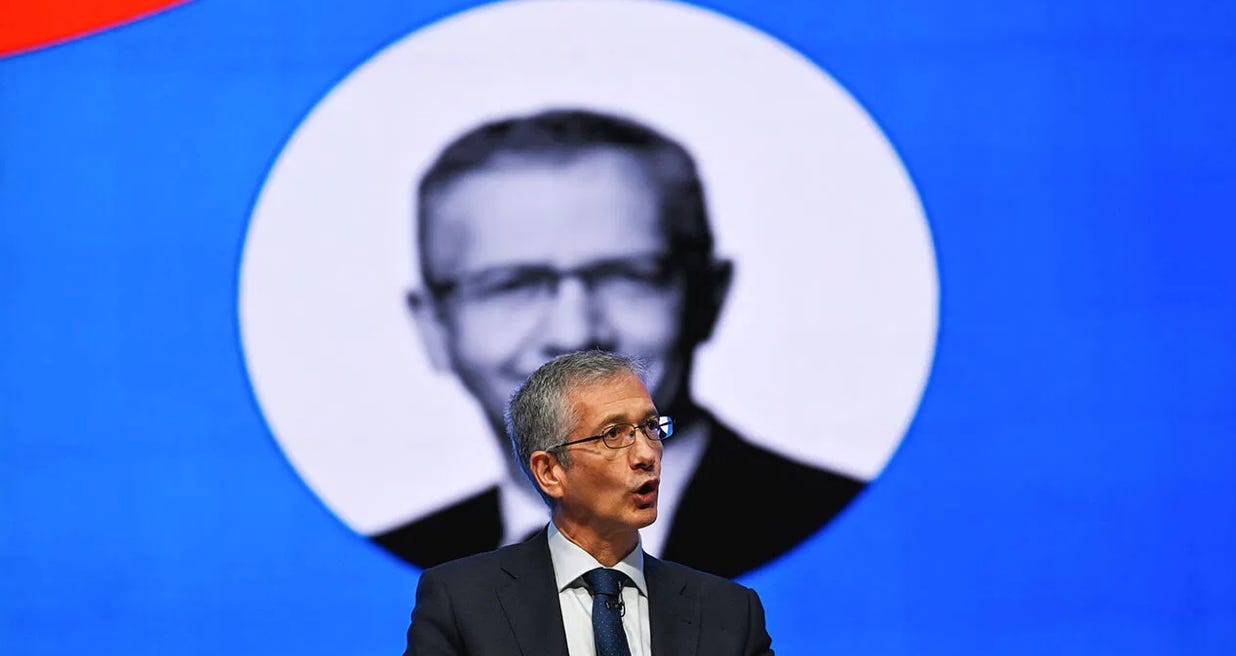
A Spaniard, a German and a Frenchwoman walk into a bank…no, it’s not the opening line of a terrible joke, it’s an update on the European Central Bank. Pablo Hernández de Cos, head of the Bank for International Settlements, is set to be confirmed by European leaders this month as the next president of the ECB. He succeeds Christine Lagarde, who steps down in February. Germany’s Markus Brunnermeier is the pick for chief economist, and France’s Laurence Boone is expected to take over Isabel Schnabel’s market operations and research brief.
Central bank appointments aren’t usually a branding story, but this one carries a lesson. Hernández de Cos is “not quite the dovish southerner of cliché”, and what proves it isn’t anything he’s said about himself; it’s that in 2023 he clashed with his own government over a pension reform he judged inadequate. Reputations are built on action - when someone makes a decision that costs them, for example - not words.
Most financial services firms try to shake off their category’s stereotype with a tagline. Name the cliché your clients attach to you, whether that’s slow, opaque or conservative, then find the decision from the past year that disproves it, ideally one that cost you revenue or an easy life. If there isn’t one, that’s a strategy problem, not a marketing one. If there is, tell that story plainly and let the evidence do the persuading.
FINTECH
Platform interfaces could disappear within five years
④ AI rewards firms that rebuild the model, not those that retrofit it.

Platform user interfaces could become largely redundant within five years, Platform One chief executive Alex Cowan-Sanluis told Money Marketing, as larger advice firms pull platform data through application programming interfaces into their own AI-driven systems. Speaking to Professional Adviser, he said menus and screens will give way to conversation: rather than searching an application, an adviser will simply ask how much a client paid into their pension last tax year.
Cowan-Sanluis and Anne Boden are saying the same thing from different corners of financial services: clients will soon stop using your website, platform or app themselves and rely on their AI agents to do it for them. Boden is building her new bank, Lockwood, around exactly that premise, “to serve customers that want to use agents”. It’s what I argued last month: your business, marketing included, has to embrace AI agents. What Cowan-Sanluis adds is where that leaves people. He wants support staff freed from “fielding mailbox requests 100 times a day” to focus on relationships. With the interface gone, what’s left is data for the agents and people for the relationship, and your brand has to work for both.
If your clients never saw your interface again, why would they choose you? Whatever that is, make sure their agents can find it, with terms, prices and service data published consistently in a form a machine can read. At larger, private equity-backed advice firms, the person deciding whether a platform can “plug into our data and AI ecosystem” is increasingly a head of data rather than an adviser. Is anything in your marketing written for them?
MEDIA & MARKETING
How AI search is outpacing B2B growth strategies
⑤ The tactics that won search 20 years ago are winning it again.

A couple of weeks ago, I attended a dinner at Bob Bob Ricard Cité hosted by B2B growth consultancy Clarity to preview their latest research into AI search and, although there were sadly no ‘Press for Champagne’ buttons in the private dining room, there were insights, discussions and opinions aplenty. This week, Clarity has published the full research report. It shows that some 85% of UK B2B marketers are actively working on their visibility in artificial intelligence (AI) answers, yet only a quarter have a defined strategy and are measuring it. Just 14% have allocated new budget to it and only 20% rank it among their top three priorities. And while 65% are confident AI describes their brand accurately, only 32% regularly check.
There’s nothing new under the sun. In the early days of search engine optimisation, what worked was publishing long-form, substantive content and backing it with earned press coverage. Then human attention spans shrank and the tactics shrank with them. Suddenly even B2B marketers were producing 7-second TikTok videos. AI has brought us full circle, because what worked 20 years ago works again on robots that don’t have our attention span problem. Yet only 19% of marketers have rethought their public relations strategy, and they rank earned coverage last of all the factors that shape AI visibility. Colin Piper, chief marketing officer at BuildOps, has it right in the report: one great piece of research beats “fifty blog posts nobody quotes”.
Start by asking your sales team what prospects are hearing about you from AI, since 81% of marketers say Sales has already raised it. Then put the questions buyers ask when they’re choosing between suppliers to the AI platforms yourself, not just the questions that test whether they’ve heard of you. Put your next content budget into one piece of research only you can publish rather than a content calendar, and get your PR and content teams fully aligned.
WILDCARD
A better way to foster rigorous debate in the boardroom
⑥ In the boardroom, silence isn’t deference, it’s indifference.

Simon & Garfunkel’s The Sound of Silence could have been written about a dysfunctional board meeting, argue Byron Loflin, global head of board advisory at Nasdaq, and Robert Straw, chief executive of China Europe International Business School Switzerland, in Harvard Business Review. In their view, boards that fail have usually had the information they needed but didn’t challenge it, because staying quiet was easier. Their remedy is “the Cartesian voice”, named after René Descartes’ method of systematic doubt. Directors ask what’s being assumed, what’s missing and what would change their minds before deciding, and chairs treat the hush after the last slide as work still to do rather than agreement.
I’d pin one of their lines on the wall of every marketing department: “Treat silence as data.” Chief marketing officers are as prone as any chair to mistaking a quiet boardroom for a won argument. Yet marketing is the one agenda item every director feels qualified to comment on, so when a marketing paper passes without a single question, it’s rarely deference. More often it’s indifference, and a plan nobody bothered to challenge won’t be defended come budget review time.
Most marketing papers are written to be approved, so write yours to be challenged. Open with the two or three assumptions your plan depends on and ask the board which one they’d bet against. Before the meeting, ask the chair to invite the most sceptical director to speak first rather than closing with “Any questions?”
Off cuts
The stories that almost made this week’s newsletter.
FINANCIAL SERVICES
😤 JP Morgan boss Jamie Dimon to set ‘example’ after Healey’s bank tax hike
🇬🇧 British Business Bank ‘throws kitchen sink’ at life sciences
💳 UK banks struggle to find boss to spearhead Visa and Mastercard alternative
FINTECH
🤯 US tech outages blamed on rush to fix bugs found by AI
🪓 Wealth fintech FNZ to axe 1,500 roles and slash office footprint
📲 Monument is the first UK bank to offer tokenised deposits to retail clients
MEDIA & MARKETING
🫱🏼🫲🏾 ‘Assets can be inherited, but relationships can’t’, says Timeline’s van den Worm
🤖 Bots are replacing reporters in cryptocurrency journalism
📊 B2B events have an ROI problem before the show starts
The last word
⑦ Guy Hands on how we must adapt in the age of AI:

“AI will not just affect finance; every area of intellectual activity will be transformed. Every business has the opportunity to benefit or be left behind. […] The UK should move quickly to be part of this transition by redesigning the education system and developing an effective regulatory framework.”
Don’t settle for marketing.
Aspire to InMarketing.
Wishing you an invaluable week,

P.S. At a loose end today? I recommend a mooch around the Royal Academy.