Inside out
Why there’s no such thing as internal communications anymore
Welcome to IMTW № 50. 🐦 Before we begin: an invitation for you. Please join the InMarketing Twitter community, a private place for readers of this newsletter to discuss great marketing and learn from one another. I hope to see you there.
👉🏻 Now, read on to learn why:
① Corporate drama now plays out in public on social media.
② We should embrace the digitally savvy, finance CEO.
③ It’s time to disband and integrate your internal comms.
④ After digitising the core, banks are looking further afield.
⑤ Interoperability is the key to unlocking DLT’s potential.
⑥ Social media in the UK will soon face regulatory scrutiny.
⑦ Remote working is having its backlash moment.
What's new?
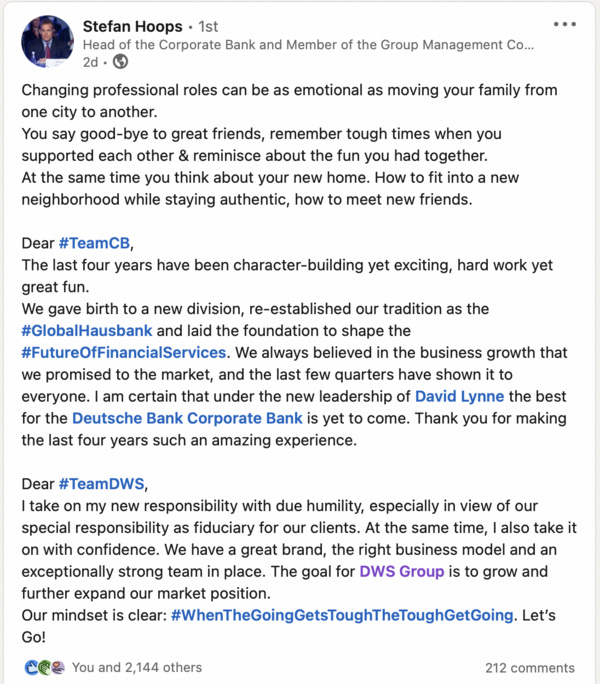
① The week began with German police raiding the offices of DWS over greenwashing allegations. By Wednesday, DWS CEO Asoka Wöhrmann had stepped down. On Thursday, it was announced that 42-year-old Deutsche lifer Stefan Hoops had been named as his successor.
In short:
Once news of the appointment had broken, Hoops took to LinkedIn to bid farewell to his colleagues in Deutsche Bank’s Corporate Bank and embrace his new DWS team. He even coined a new hashtag to inspire them: “Our mindset is clear: #WhenTheGoingGetsToughTheToughGetGoing.”
DWS Group’s corporate LinkedIn account then shared a longer version from an internal email Hoops had sent its people. It was slightly gushing about Wöhrmann and his legacy.
Hoops then added the hashtag he’d coined in his original LinkedIn post - to the corporate account’s post. It was something of a public love in and all rather…un-banky.
Why does it matter?
② It’s not unusual for leaders from other sectors - notably technology - to do their internal comms in public. Elon Musk seems to do a lot of his management on Twitter (see One more thing… below) and, also this week, Klarna CEO Sebastian Siemiatkowski did his downsizing on LinkedIn. But finance has always been a little more buttoned-up, with clear divisions between what gets said in public and what is shared behind closed doors. Now, with a new generation of leaders emerging, that reticence is breaking down. The age of the digitally savvy, finance CEO is upon us. And we should embrace it.
I have no doubt Hoops’ internal email and personal LinkedIn post were scrutinised by the Bank’s Compliance and Comms teams before publication. But they still read as less formal and more genuine than most. Crucially, he took the lead by posting and commenting from his own account - not leaving the corporate comms people to do it. That kind of transparency and autonomy is important in fostering trust and engagement on social media.
Combine this refreshing approach with the undeniable truth that - in the age of smartphones with cameras, mics and screen grab functionality built in - internal messages frequently leak out anyway and the lesson is simple: there is no such thing as internal communications anymore.
What's next?
Take action
③ If you still have an internal communications function, it’s time to disband and integrate it fully with your communications or marketing teams.
That’s not to say there isn’t still a need to consider your staff as a distinct audience; of course you should - they have different needs than your other audiences - but the overall messaging needs be the same and your comms should emanate from the same team. Whatever you share internally will ultimately become public so make sure its aligned - in substance and style - with your external comms.
Get help
Visit InMarketing, my resource library for leaders in finance or technology who want to innovate, interact and influence.
Join my InMarketing Twitter community, where you can ask questions or comments of me but also your fellow community members of senior marketing practitioners.
Share
Can I ask you a favour? If you found this useful or know someone who would, please share it. It would really help me to grow the community of regular IMTW readers.
What else?
Three other articles that are worthy of your time.
FINANCE
JPMorgan exec: Payments systems are the future
④ After digitising core services, banks are looking further afield.
“JPMorgan Chase is amping up its investments in payment processors, and — according to the global bank’s head of innovation and corporate development — everyone else in the financial services industry should follow suit.”
“Banks with the ability to custody the digital assets of clients and be competitive in the landscape are going to be the most successful in coming years, he added.”
“Digital banking is only going to continue ramping up, Balkin said, meaning the focus on virtual is more important than ever. In 2021, more than 65% of JPMorgan accounts were opened online, analysts said. ”
TECHNOLOGY
CBDCs now hold wholesale appeal for central bankers
⑤ Interoperability is the key to unlocking DLT’s potential.

“The world’s big central banks are becoming more interested in using distributed ledger technology, or blockchains, themselves. What is sparking establishment interest is using central bank digital currencies for wholesale cross-border payments, to move funds between financial institutions and central banks.”
“One key block is that there is still no ‘interoperability’ between these separate pilots. But if this does emerge — i.e. scaleable systems are created — there would be further interesting implications.”
“Future historians might conclude that the most significant long-term consequence of distributed ledger technologies for finance was not bitcoin and other cryptocurrencies. Instead, it lay in deeply dull corners of banking, like wholesale payments.”
MEDIA & MARKETING
Social media giants are failing women, finds Ofcom
⑥ Social media in the UK will soon face regulatory scrutiny.
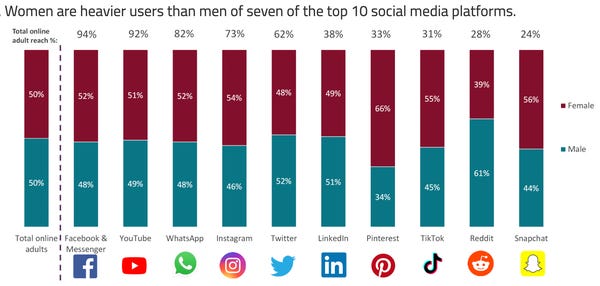
“Ofcom said it has found that female internet users in the U.K. are less confident about their online safety than men, as well as being more affected by discriminatory, hateful and trolling content.”
“Under the Online Safety Bill that’s currently before Parliament — which is set to introduce a duty of care on platforms to protect users from a range of illegal and other types of harms — the regulator will be able to fine rule-breakers up to 10% of their global annual turnover. Its remarks can be seen as a warning shot across the bows of social media giants like Facebook and Instagram owner, Meta, which will face close operational scrutiny from the regulator once the law is passed and comes into effect — likely next year.”
“The research highlights the greater impact negative online experiences can have on women’s mental health, especially for younger women and black women — with Ofcom finding that women aged 18-34 were more likely than any other group to disagree with the statement that ‘being online has a positive effect on my mental health’ (23% vs. 14% for the average U.K. adult, and 12% of men).”
One more thing...
⑦ In a sign that the backlash against remote working may be upon us, Elon Musk told Tesla staff this week that he wants them back at the office. The Verge has the story.

“In an email apparently sent to the company’s executive staff with the subject line ‘Remote work is no longer acceptable,’ the CEO said employees must spend a minimum of 40 hours per week in the office, or else ‘depart Tesla.’ He said this should be a ‘main Tesla office,’ and not a ‘remote branch office.’”
Off cuts
The stories that almost made this week’s newsletter.
FINANCE
🌐 Former Swift chief Gottfried Leibbrandt takes the chair at CLS
👮🏻♂️ BNP Paribas’s head of FI services: keep it regulated
👐🏻 Fidelity digital assets to double headcount by end of year
🇬🇧 London ‘most attractive’ European city for FDI
🏦 Barclays to shutter 27 more branches (103 closed this year)
TECHNOLOGY
👩🏻💻 What Sandberg’s exit reveals about women’s progress in tech
🧀 Copper’s Swiss unit gains regulatory nod for AML standards
👯♂️ Gemini lays off 10% of workforce
🧩 Thunes integrates with TrueLayer for open banking payments
👨🏽💼 Barclays Bank UK CEO Ashok Vaswani joins Pagaya as president
MEDIA & MARKETING
🐦 Twitter shifting away from Spaces, newsletters, and communities
📹 Temenos’ CMO explains ‘Everyone’s Banking Platform’
The last word
⑦ David Jones, chief executive of The BrandTech Group on Sheryl Sandberg, who announced this week that she is stepping down from her COO role at Meta later this year:

“Facebook would not be Facebook without Sheryl. She built the foundation that allowed Facebook to grow into what it became — good and bad.”
Don’t settle for marketing.
Aspire to InMarketing: innovate, interact, influence.
Have a productive week.
