Mountain to Mohammed
It's time to bring your audience back to your own platform.

Read on to learn why:
① Forward-thinking media organisations are going back to the future.
② Your stories deserve a platform of their own, worthy of your audience.
③ Real use cases and proper regulation will unlock digital asset benefits.
④ The barriers to institutional adoption of blockchain continue to tumble.
⑤ Journalists want public relations people to help not hinder them.
⑥ The battle for talent is heating up and forcing banks to think creatively.
⑦ No one wants brands commenting on societal affairs.
What's new
My favourite tech media title, The Verge, launched a new website this week.
① In short:
“Our goal in redesigning The Verge was actually to redesign the relationship we have with you, our beloved audience. Six years ago, we developed a design system that was meant to confidently travel across platforms as the media unbundled itself into article pages individually distributed by social media and search algorithms.”
“But publishing across other people’s platforms can only take you so far. And the more we lived with that decision, the more we felt strongly that our own platform should be an antidote to algorithmic news feeds, an editorial product made by actual people with intent and expertise.”
“We’re back to basics with something we’re calling the Storystream news feed, right on our homepage. Our plan is to bring the best of old-school blogging to a modern news feed experience and to have our editors and senior reporters constantly updating the site with the best of tech and science news from around the entire internet.”
Why it matters
I’ve long been fascinated by online journalism so a relaunch like this was always going to catch my eye but it should matter to you too because, as we talked about back in issue 10, brands that want to get noticed need to become storytellers, they should be thinking like media organisations.
Disregard the new logo, fonts and colour palette - what’s notable about The Verge’s new approach is that it is moving away from a trend that has dominated media for at least a decade - that of seeking out your audience wherever they already are (typically social media channels) - and towards the concept of creating a compelling platform of their own to attract the audience.
② Depend on social media to get your story out and you’re at the mercy not just of those platforms’ users (who often sully the mood) but also the changing whims of the tech companies running the platforms (take for example Instagram’s pivot to video that has left so many publishers in the lurch.) The Verge’s move matters then because it gives marketers a steer on how they should be thinking: it’s time to create a platform of our own, worthy of attracting our audience and, in so doing, reduce our dependence on social media channels.
What to do about it
Take action
I’m not advocating abandoning your social media marketing - far from it - but I do think it’s time to have a long, hard, critical look at your own website and to ask yourself some questions:
Is our content as compelling as that of my favourite newspaper?
Is the site beautiful to look at and to use?
Are we delivering value rather than just self-promoting?
Have we got an enticing mix of media, including video, animation and infographics?
Do our readers have the ability to engage - either through commenting or joining a newsletter?
Is there a clear path for readers that leads them from one story to the next?
Is it easy and obvious for readers to share our stories with their own networks?
When appropriate, do we have the courage to point our readers to great content on other sites?
Will readers want to bookmark our content hub and return regularly?
The answer to every single one of these questions needs to be ‘yes’. Otherwise, you have work to do this week.
Get help
Visit InMarketing, my resource library for leaders in finance or technology who want to innovate, interact and influence.
Join my InMarketing Twitter community, where you can ask questions or comments of me but also your fellow community members of senior marketing practitioners.
Share
Can I ask you a favour? If you found this useful or know someone who would, please share it. It would really help me to grow the community of regular IMTW readers.
Top stories
The other articles that are worthy of your time.
FINANCE
How traditional finance can embrace crypto
③ Real use cases and proper regulation will enable financial institutions to benefit from digital assets.

“The central advantages of blockchain technology are
decentralisation,
immutability, and
instant finality of any transaction.”
“It therefore stands to reason that any activity looking to employ blockchain technology must be deficient in one or more of these areas. Anything, therefore, where transactions are slow, or expensive, or have an unnecessary, probably rent-seeking middleman or where the transactional process itself cannot be trusted. This applies to a large slice of economic activity:
Supply chains often have disproportionately penal working capital arrangements.
Foreign exchange fees can be crazily high for what is at face value – a simple function.
The property market is opaquely priced and illiquid.
Fund tokenisation: KKR, for example, just announced that one of their funds would be partially tokenised on the Avalanche blockchain, a welcome expansion in accessibility to private equity.”
“Proper regulation inevitable. Once it is in place, the growth of professionally managed investment products will channel capital into those parts of the asset class which genuinely merit it. From the perspective of both developer and investor, this would be a healthy outcome, and enable economies to nurture and benefit from the emergence of this new asset class.”
TECHNOLOGY
‘Historic’ moment as Ethereum Merge finally completed
④ The barriers to institutional adoption of blockchain continue to tumble.
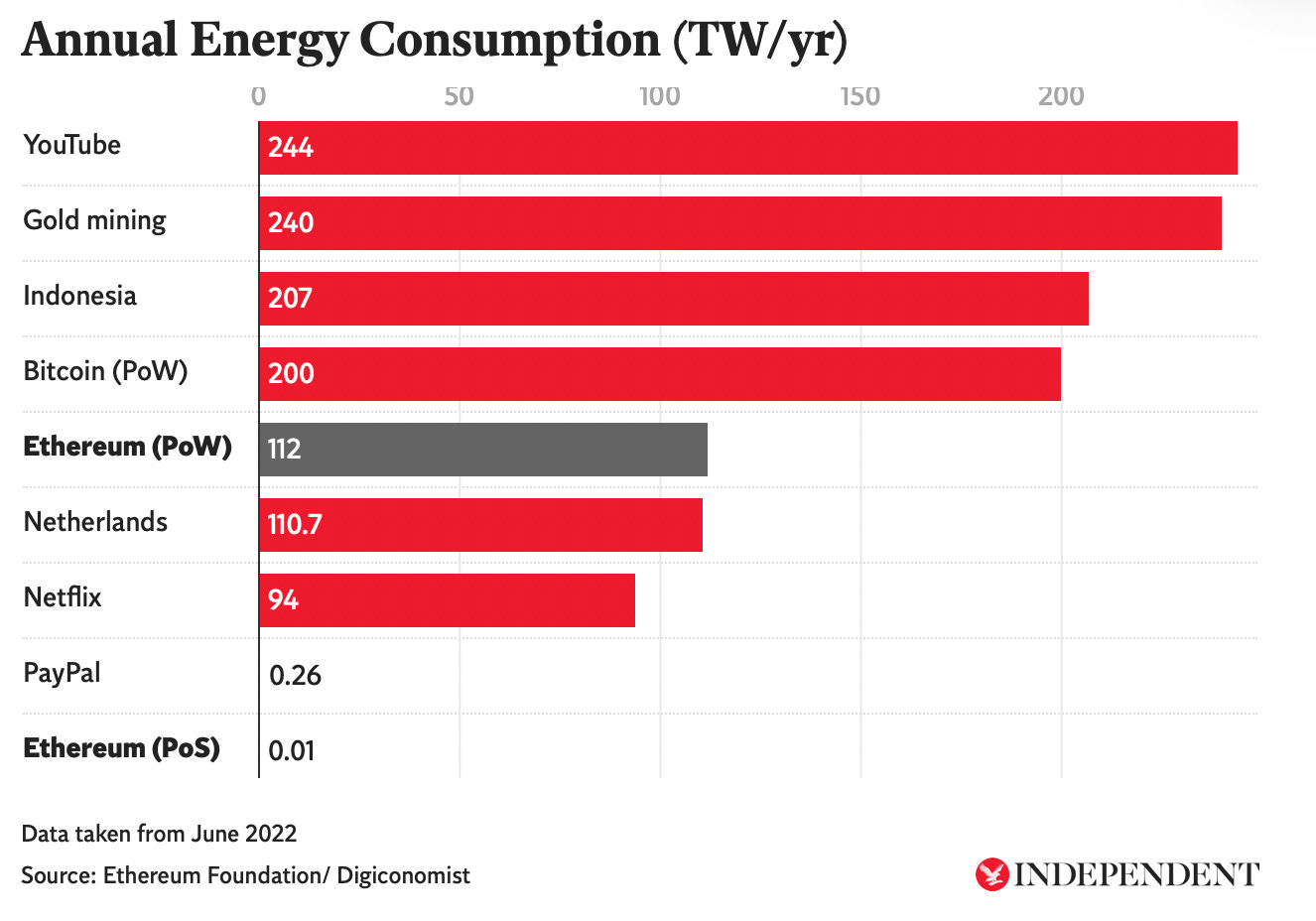
“At 7.45am BST on Thursday, Ethereum completed what has been dubbed ‘The Merge’. In doing so, the energy consumption of the world’s second largest cryptocurrency dropped by more than 99 per cent in an instant.”
“The Ethereum Merge involved a complex network transition from proof-of-work – a technoogy pioneered by bitcoin – to proof-of-stake, meaning vast computing power is no longer needed to support transactions and the minting of new units of the crptocurrency.”
“‘The Merge is a significant step forward bringing Ethereum into the mainstream, and it marks an evolution of blockchain technology,’ said Gilbert Verdian, CEO of blockchain firm Quant. ‘A smaller carbon footprint has long been an industry goalpost... Now that this is happening, we will see more institutional adoption where financial services turn to decentralised infrastructure. It can offer safe and secure transaction processing at a fraction of the cost, when compared to the enormous expense and burden of today’s infrastructure’.”
MEDIA & MARKETING
Pitching to journalists: A guide
⑤ Journalists want public relations people to help not hinder them.
Tech reporter Haje Kamps took to Twitter this week to offer some advice on how to pitch stories to him (and indeed most journalists):
Do your research: Know what a writer cares about before you pitch.
Make sure you have a hard news angle: That means a new product launch, a fundraising round that hasn’t been announced yet, something monumental in a company’s history that might prove to make or break the company.
Write an amazing press release: Here’s how.
Email it: Don't send DMs on Twitter, don't call.
WILD CARD
Citi opens Málaga hub for junior bankers
⑥ The battle for talent is heating up and forcing banks to think creatively.

“Citigroup has opened its new hub for junior investment bankers in the beachside Spanish city of Málaga, insisting the move is more than a gimmick as Wall Street lenders battle for young talent amid criticism of burnout in banking.”
“The US bank selected 27 analysts from more than 3,000 applicants for the two-year programme, which started on Wednesday. Promising eight-hour days and work-free weekends, it aims to distinguish itself from the punishing seven-day working weeks common for young staff in London and New York.”
“By locating it in Málaga — a sunny, culture and food-orientated city on Spain’s southern coast that is far from the world’s biggest financial hubs — Citi is also seeking to offer a more alluring lifestyle and a different path into banking for those less keen to return to a city-centre office in Canary Wharf or Manhattan after the pandemic.”
Off cuts
The stories that almost made this week’s newsletter.
FINANCE
🦁 ING overhauls innovation strategy
🍎 Goldman’s Apple Card business has a surprising subprime problem
📈 Credit Suisse poses idea of equity stake for investment bankers
📉 J.P. Morgan’s investment banking fees could drop 50 per cent
🪴 After scrapped Wealthfront deal, UBS goes organic again
TECHNOLOGY
🇺🇸 White House sets out digital asset framework
💦 Tokenisation of illiquid assets to reach $16T by 2030
⛓ SWIFT trials blockchain platform for corporate actions
💵 J.P. Morgan backs $20M round for blockchain infrastructure startup Ownera and signs agreement to acquire Renovite
🏦 CBDCs: Norwegian central bank to use Ethereum and ECB partners with Nexi
MEDIA & MARKETING
🌍 Brands take note: The purpose of purpose is purpose
🧽 Communications around pensions branded 'as dull as dishwater'
💰 Adobe snaps up Figma for $20B
The last word
⑦ An anonymous crisis communications consultant speaking to The Drum this week about how brands should react to the death of Queen Elizabeth II.

“If you have a royal warrant then it’s fine to put something out there, but otherwise just shut the fuck up.”
Don’t settle for marketing.
Strive for InMarketing: innovate, interact, influence.
Wishing you a productive week,

P.S. I discovered the bar at Beaverbrook Town House this week. Just off Sloane Square, it’s a delightful little bolthole for a drink after work. I think you’d like it.
