Seismic City Tours
Genuinely personalised content is a key part of scaling trust across every client interaction.

Read on to learn why:
① No two client experiences should look the same.
② The real trick isn’t reaching the right person, it’s having the right piece of content for them in the first place.
③ When your brand is clear, useful and consistent, clients will advocate for you.
④ The bar to clear for a successful technology deployment is lovable, not viable.
⑤ In public relations, the three-martini lunch may not be dead after all.
⑥ Using AI as a scapegoat for bad news destroys trust.
⑦ The real risk of your pricing strategy is that your clients feel treated unfairly.
But first, I’d like to introduce you to Archie. Archie is my editorial AI agent. I’ve been working with him for a while now to help research this newsletter. And every week, he offers to do more and more for me....do I want him to draft the copy? Do I want him to select the news articles for me? Do I want him to suggest key takeaways? No! It’s important to me - and I believe to you - that a newsletter with my name on it was written by me, not a robot.
So, at risk of losing my job to AI, I gave him another one instead. Archie is now writing his own newsletter. He’s got more ‘bandwidth’ than me so he publishes every weekday at 17:00. It’s called InMarketing Today, “the daily debrief for leaders in B2B financial services and fintech.” InMarketing This Week is and always will be weekly, written by me, and focused on offering considered human insights and actionable ideas. Let’s dive into this week’s issue…
🚨 What's new
I attended the London stop of Seismic’s City Tours on Thursday. And, while it’s perhaps not entirely coincidental that an event hosted by a vendor of content management solutions for sales enablement should conclude that content management is the solution to better sales enablement, since I happen to agree, I’m happy to report some highlights of the day to you.
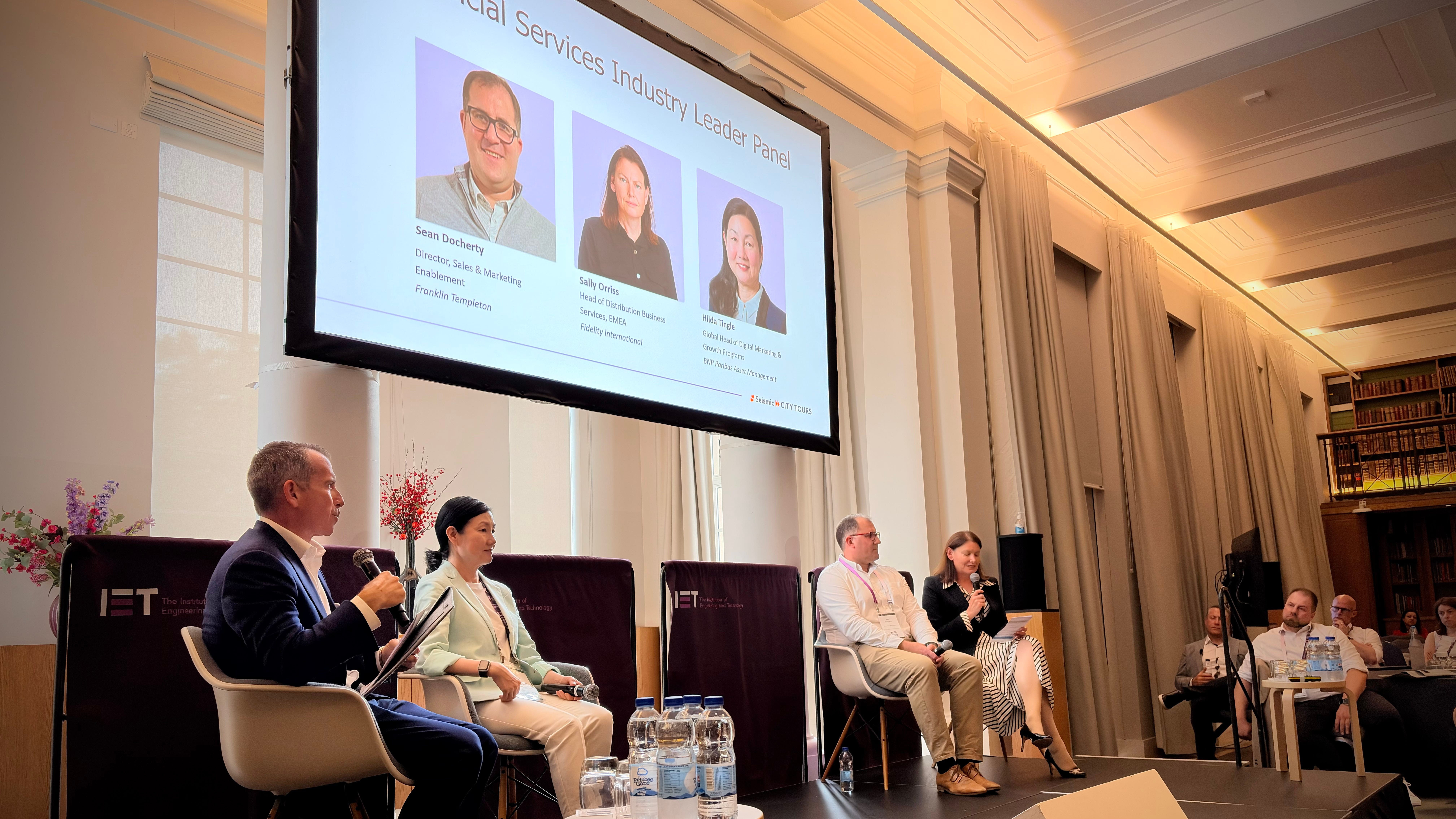
The standout session was “Scaling trust across every client interaction”, built around a panel of three senior distribution and marketing leaders: Sean Docherty of Franklin Templeton, Sally Orriss of Fidelity International, and Hilda Tingle of BNP Paribas Asset Management.
① The shared challenges were familiar: relentless market volatility, regulatory and pension reform that demands fast client communication, a generation of digital-first self-directed investors, consolidation across the industry, and fee compression. The answer was AI-enabled personalisation at scale — moving away from one-size-fits-all sales decks towards content tailored to each client and adviser, with compliance embedded in the workflow rather than bolted on at the end. The phrase that stuck was the “Netflix effect”: no two client experiences should look the same.
The session closed on three takeaways. First, that content now sits at the frontline of client trust. Second, that AI only scales when confidence scales — in the content, the guidance and the compliance guardrails. And thirdly, growth and control are no longer opposing goals. The firms that connect intelligence, compliance and engagement into one operating model will be the ones that win as the industry consolidates.
💡 Why it matters
Strip away the Seismic product marketing and this session did also articulate the real prize: getting genuinely relevant content to the right client at the right moment is one of the most trust-building things a firm can do — and for the first time technology can now deliver it at the scale our industry actually operates at. That’s exciting.
A note of caution earned by history, though. Our industry has promised personalisation before and largely fluffed it; Gartner once predicted most marketers would abandon the effort, undone by poor data and absent returns. What’s changed since then isn’t a sudden surplus of marketing talent, it’s that AI removes the delivery bottleneck. The catch though is that AI distributes whatever you give it — including thin, me-too content — only faster, and now personally addressed.
② The real trick isn’t reaching the right person, it’s having the right piece of content for them in the first place. You need to understand your clients well enough to know which of them will want what. The focus needs to be upstream: your data, your understanding of the client, and the substance of what you have to say.
✅ What to do about it
Take action
Talk to your head of marketing this week about:
Fixing the data foundation before the clever bit. Personalisation runs on deep, reliable, well-governed client data, monitored continuously rather than audited occasionally. More data is not the goal; trustworthy data is. Get this wrong and AI will just scale the error.
Knowing your ideal clients well enough to personalise on the signals that matter. Effective tailoring rarely needs everything you hold on someone; it needs the few things that genuinely shape their decisions. That is a function of how well you understand your ICPs, not how much you have collected.
Investing in content with something to say. Targeting cannot rescue a generic point of view. When I was at Quant, reaching a corporate treasurer wouldn’t have mattered unless we had a specific message that spoke to their pain points around liquidity management. Give AI some substance worth distributing, or it will simply spread the blandness faster.
Get help
I am currently pursuing senior marketing and communications leadership roles — ideally a permanent position, although I'm also taking on a small number of fractional and interim engagements. If you need help growing your business’ recognition, reputation and revenue - or know someone who does - let's talk.
🗞️ Top stories
The other articles that are worthy of your time this week.
FINANCIAL SERVICES
Monzo retains its title as Best British bank at Smart Money People’s British bank awards
③ When your brand is clear, useful and consistent, clients will advocate for you.

🚨 Monzo won the award for the second year running — and added Best Current Account Provider to its haul while also retaining Best Children’s Financial Provider. I like these awards because they’re not decided by an industry panel, but more than 229,000 customers, through reviews collected over 15 weeks across 29 categories. Those reviews kept returning to the same things — the app, the budgeting tools, the sheer ease of managing money.
💡 A brand people love is rarely the product of a clever campaign. It’s the cumulative product of thousands of small, useful, clearly communicated moments — which is precisely what these awards measure, because customers vote in their own words. Monzo’s advantage is not louder marketing; it’s a plain-spoken, grown-up voice married to a product that genuinely helps people manage their money. Clarity, usefulness and consistency: get those three right and your customers do your marketing for you.
✅ Treat brand love as an operational outcome, not a marketing one. Audit every customer touch point — onboarding, the app, a complaint, a monthly statement — and ask whether each is clear, useful and recognisably human in tone. Then make advocacy a board-level metric: measure what customers say about you unprompted, not just the scores they tick in a survey. The brands people love are the ones whose customers can explain, in their own words, exactly why.
TECHNOLOGY
Royal London Asset Management implements Seismic
④ The bar to clear for a successful technology deployment is lovable, not viable.

🚨 Back to Seismic City Tours for our technology story this week… Ed Venner, Chief Client Officer and Michelle Calcutt, Head of Client Group Services - both from Royal London Asset Management - delivered a keynote on their project. The asset manager is five months into rolling out Seismic’s sales enablement platform across its business. Two choices stood out. The firm deliberately bought more capability than it needs today — a bet on future growth it’s entirely comfortable with — and it launched not with a minimum viable product but what it calls a “minimum lovable product”: the smallest thing its people would actually want to use, rather than merely put up with.
💡 The gap between viable and lovable is the whole point. Viable is an engineering bar — does it work? Lovable is a marketing one — will people choose to use it without being told to? Most technology rollouts in financial services clear the first and quietly fail the second, which is how firms end up with costly platforms gathering dust. RLAM put it plainly: systems don’t build trust, people do. A tool people resent is a tool they route around, and in a business where trust is the product, clients will eventually feel internal friction.
✅ Before your next platform decision, change the question you’re asking. Not “is it live?” but “do our people reach for it unprompted?” Set the launch bar at lovable rather than viable, measure success by adoption rather than deployment, and design around what each role actually needs to do its job well — RLAM built personas to do exactly that.
MEDIA & MARKETING
Journalists using AI to save time but don’t want AI-generated pitches or press releases
⑤ In public relations, the three-martini lunch may not be dead after all.

🚨 Cision’s 2026 State of the Media report, drawn from nearly 1,900 journalists across 19 markets, finds AI now firmly embedded in the newsroom: only 21% say they don’t use it, down from a third a year ago, mostly for brainstorming, research and transcription. But when it comes to PR, the door is shut. More than half (53%) oppose receiving AI-generated pitches and press releases, citing marketing spiel, unsourced claims and plain irrelevance as their chief frustrations.
💡 I think AI is making old-fashioned PR more valuable than ever. As AI search reshapes how people discover information, large language models lean heavily on authority signals — and a credible press mention is among the strongest. So earned coverage is even more important, while the scaled, AI-written pitch journalists are now filtering out is precisely the outreach least likely to win it. The unglamorous craft of knowing your journalists, and knowing their readers even better, has quietly become a competitive advantage rather than a cost.
✅ Choose the handful of journalists who genuinely matter to your market and invest in them properly — their beat, how they like to be approached, and above all what their readers care about. Then pitch the story those readers want, not the product you want to sell. No one cares about your new product; they care what it means for them. In the AI era, the firms that earn coverage will be the ones still doing the unscalable, human work everyone else is automating away. Maybe there’s still room in the PR toolkit for the three-martini lunch after all?
WILDCARD
How should bosses talk about AI?
⑥ Using AI as a scapegoat for bad news destroys trust.

🚨 Bill Winters, chief executive of Standard Chartered, drew criticism for describing a planned 15% cut to back-office roles over four years as replacing “lower-value human capital” with financial capital invested in automation. The Economist’s verdict is that the phrasing was the error, not the underlying plan: the bank had in fact made pre-emptive efforts to redeploy affected staff. The research it cites, covering more than 16,000 UK employees, found that job insecurity dents employee commitment far less when workers judge their bosses to be honest, reliable and fair.
💡 The words are the work. Winters had a defensible plan and undercut it with four careless words. “Human capital” reduces people to a line on the balance sheet, and once you have sorted them into higher and lower value, no amount of good intent survives the phrasing. In financial services, where trust is the entire proposition, internal communication is reputation management — what a chief executive says to staff reaches the headlines by lunchtime.
✅ Brief your leaders before they talk about AI, not after the apology. Strip out the balance-sheet shorthand — capital, headcount, resource — and say what you mean in plain English. Then pair every message about automation with a concrete answer to the question every employee is actually asking: what happens to me? Standard Chartered had that answer in redeployment and reskilling, and buried it under jargon. Lead with it instead.
✂️ Off cuts
The stories that almost made this week’s newsletter.
FINANCIAL SERVICES
💰 Jamie Dimon says JPMorgan could spend up to $20bn on a new acquisition
🇬🇧 UK’s biggest banks back scheme to challenge Visa and Mastercard dominance
🥊 Commerzbank rallies shareholders in fight for independence from UniCredit
🕺🏻 Deregulation hands top US and UK banks $1.3tn opening
🙋🏻♂️ Affluent investors rely on advisors for private market investments
TECHNOLOGY
🇪🇺 ECB summons banks to urge them to fix flaws exposed by latest AI models
⛪️ Pope Leo calls for AI to serve humanity and not concentrate power
🏦 Even JPMorgan Payments feels pressure to compete with fintechs
👶🏻 Fintech, once the ‘enfant terrible’ of finance, is growing up
👋 HSBC emerging technology chief Glasner departs
MEDIA & MARKETING
📲 Monzo spends heavily on ‘refer a friend’ rewards to boost market share
🗣️ Poor investor communication is holding back Britain’s listed companies
🤖 AI is not the skill email marketers need most
🦾 How to use B2B PR to shape what AI recommends
👏🏻 ServiceNow CMO to join OpenAI
🎤 The last word
⑦ Zephyr Teachout on why surveillance pricing is predatory:

“The reality is that it is not a personalised service but a way to employ the same data infrastructure that social media uses to sequence feeds, only here the information doesn’t determine what someone sees but what they pay or are paid.”
Don’t settle for marketing.
Aspire to InMarketing.
Wishing you an inspiring week,

