The unimaginable
Why a humanitarian crisis calls for restraint, focus and helpful, pragmatic action - never hollow words
Welcome to IMTW issue № 48. Apologies for being MIA last weekend. I was visiting dear friends in Brussels and working on an excellent bottle of Croze-Hermitage. Oh, and this tender piece of veal with morels:

As you can see, I stood no chance of also getting IMTW to you.
👉🏻 This week though, I’m back. Read on to learn why:
① A crisis calls for action, not words.
② Doing nothing is better than trying to profit from a crisis.
③ How Swift works remains widely misunderstood.
④ The UK still has work to do to harbour innovation.
⑤ Lead generation shouldn’t be limited to your website.
⑥ A good mantra is more powerful than vision or mission.
⑦ Customer experience depends on your employees.
What's new?
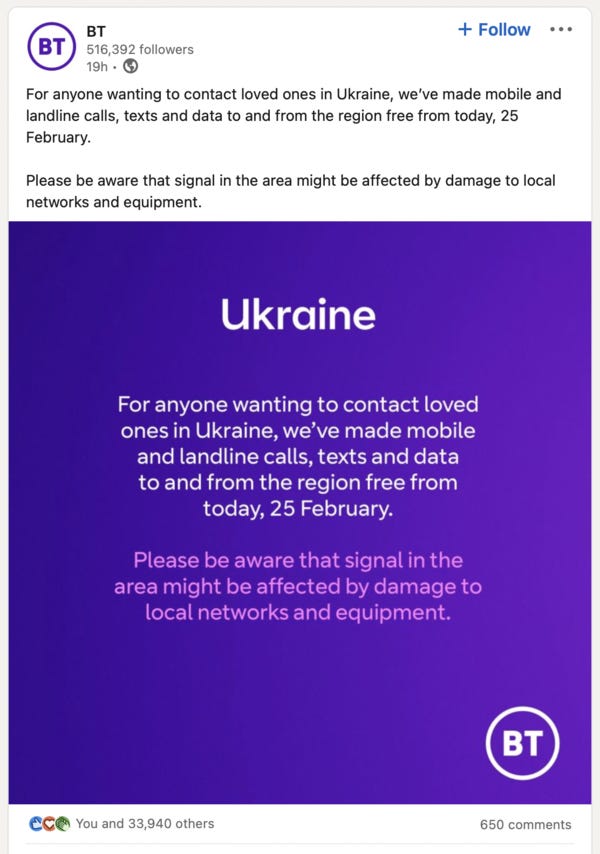
① The world watched in horror this week as Russia invaded Ukraine. BT was swift to react and posted this on Friday.
In short:
BT has made all communications to and from Ukraine free.
No T&Cs, no fuss, no fanfare.
The public’s reaction has been overwhelmingly positive.
Why does it matter?
BT’s action this week was a pitch perfect example of how to react to a humanitarian crisis. While other brands were cobbling together ‘our thoughts are with’ or ‘we stand united’ communications with varying degrees of sincerity and little substance, BT quietly looked at its businesses and identified something tangible and positive it could do to help those affected. Then did it. Without virtue signalling, without fanfare, without any attempt to prosper from it.
② Contrast BT’s class and grace with hapless Brewin Dolphin. The investment manager hit the headlines this week when it transpired it had used escalating Russian aggression as an excuse to drum up attendance at one of its webinars.
James Robertson of Active Financial Planners told Money Marketing he believed Brewin’s email “crossed the line” and he was shocked the first thing the company could think about was “how to take advantage of the situation” to promote what it does.
What's next?
Take action
I’ve advised you in the past that your brand should engage with customers and stay relevant by reacting to news stories and adding its own voice to the discussion. But a crisis like the one unfolding in Ukraine, in which innocent people are being harmed, is not one of those times. Less is more. Some suggestions:
Look after your people: You may have colleagues directly impacted. They may be in Russia, in Ukraine or further afield. Put in place whatever practical measures you can to help them. Communicate clearly about these initiatives internally. Don’t say a word about them externally.
Consider your community: Think about your other business contacts too. Whether they be suppliers, partners or customers, reassess your communications with them in light of events in the world.
Avoid hollow virtue signalling: Tempting though it may be to join the other brands putting out words of sympathy and Ukrainian flags, remember that those kinds of sentiment are best expressed by individuals and - as with any marketing message - your brand’s words should always be substantiated with facts. Which leads me to…
Act if you can: If, like BT, your business is such that there is something tangible and practical you can do to help those impacted by a crisis, then do it. Just quietly get on with it.
Read the room: While I’m not suggesting that all other marketing and communications should grind to a halt, it’s crucial to keep in mind that the mood has shifted and what was an innocuous message when it was scheduled a week ago may no longer be appropriate. Review your plans.
Get help
Visit InMarketing, my resource library for leaders in finance or technology who want to innovate, interact and influence.
If you have a question or comment, just hit ‘reply’. I’d love to hear from you.
Share
Can I ask you a favour? If you found this useful or know someone who would, please share it. It would really help me to grow the community of regular IMTW readers.
What else?
Three other articles that are worthy of your time.
FINANCE
The impact of throwing Russia out of Swift
③ How Swift works remains widely misunderstood.
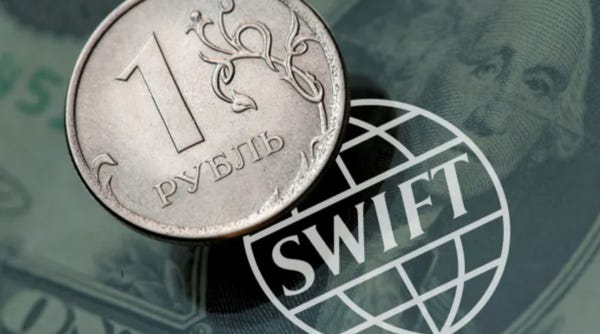
“Swift is not actually a payments system, but a messaging platform. However, the relative strength of its security features and the breadth of its usage mean that it enables banks to send trillions of dollars’-worth of money across borders daily.”
“There’s no reason why other messaging services, email, or telephone couldn’t serve as options in the event of a Swift ban. In practice, if you want to send money around the world relatively quickly, reliably, and cheaply, then not really. Ambitions to create a rival payments network have, so far, been useless. This isn’t down to the tech (or even the platform’s standardisation of payment instructions into a convenient lingua franca). Rather it reflects the balance of power in global finance.”
“What explains banks’ reluctance to bypass Swift, even for transactions that are above board? It’s all about the omnipotence of the greenback. About half of all global payments are made in dollars. Along with about 90 per cent of trade finance. When instructions are sent via networks such as Swift, many of those dollar payments need to be made between institutions that do not have accounts with one another. What that means is that a correspondent bank — probably with operations in the US, policed by the American authorities — will act as an intermediary.”
“Without access to Swift, it would become nigh-on impossible for Russian companies to be paid in a timely or reliable way. Without access to correspondent banking services in the US, it would be nigh-on impossible for Russian exporters to be paid at all. This is what’s called the ‘weaponisation of finance’, where Washington uses the dollar’s dominance to further the aims of US foreign policy.”
“A total cut-off from Swift would be very damaging for Russia; it could also cause issues for the longevity of Swift. It would clearly show the degree of US control. The BRICS are already working on their own version of the network. And, while they are still probably some years away from launching it, a ban on Russia may well speed their timeline up.”
TECHNOLOGY
FinTech CEOs call for bolder action on Kalifa Review
④ The UK still has work to do if it wants to harbour innovation in financial services.
“A group of over 70 fintech chief executives and leaders have signed a letter calling for bolder action to realise the aims of the Kalifa Review.”
“The letter said, ‘though good progress has been made by the government, regulators, and industry’ that ‘rather than resting on our laurels, it is imperative that we continue to build on this momentum and work together to establish an environment in the UK that is even more supportive of and conducive to innovation in financial services’.”
“The letter said that the ‘regulatory rule book requires further updating’, and recommended the introduction of a full UK crypto regulatory regime, as well as the extension of Open Banking to new areas.”
Meanwhile: Europe’s fintech finest are fleeing to crypto… 🏃🏻
MEDIA & MARKETING
7 Tips for better LinkedIn leads
⑤ Lead generation shouldn’t be limited to your website.

Use your company page as a lead generation page
Create your showcase page
Encourage your employees or coworkers to link to your profile
Add CTAs to your content
Form groups
Search for people and groups
Keep track of who’s tracking you
One more thing...
⑥ I’ve liked the idea of using a mantra ever since I heard Guy Kawasaki enthuse about them during his closing plenary at Sibos years ago. This week, HBR wrote about how to use them to be a more inclusive leader.

In short: “One of the greatest challenges facing leaders today is creating a culture of inclusiveness, where all members are treated equitably and feel equally valued. To develop truly inclusive behaviors, leaders must take actions — including using the ‘mantra’ technique — to ensure their behavior has the intended impact. A mantra is a phrase that is repeated silently before entering a challenging context to focus the mind and body on a clear, unambiguous intention.”
Off cuts
The stories that almost made this week’s newsletter.
FINANCE
💷 Hargreaves Lansdown to spend £175m
🤝 NatWest partners with AWS on personalised banking
🧹 Swiss banks struggle to move on from murky past
🥇 Private equity returns beat listed stocks again
📉 London Stock Exchange acquires TORA
TECHNOLOGY
🇬🇧 Matt Hancock: The UK should be the home of fintech and crypto
🧗🏻♂️ HSBC tech spend climbs to $6B in 2021
🥂 Lloyds to launch digital advice for mass affluent customers
🍉 BNY Mellon plans to launch digital asset custody platform
📲 Finary wants to reimagine private banking
MEDIA & MARKETING
🎙 New JP Morgan Chase CMO Carla Hassan
The last word
⑦ Brian Solis, talking to McKinsey about reimagining the future of marketing and why CMOs will drive business growth:

“The number-one question that I get from executives is where do I start? Start with the customer. But don’t stop with the customer. You have to remember that the employee is also part of the customer experience.”
Don’t settle for marketing.
Aspire to InMarketing: innovate, interact, influence.
Have a productive week.
